What We Preserve
Family heritage encompasses far more than we imagine — from ancestral knowledge to migration journeys, from traditional recipes to digital archives.
Family Heritage
What It Means
Family heritage is the complete story of a family across all its generations — where it began, how it moved, what it built, and what it stands for. It encompasses origin stories, migration journeys, defining moments, collective achievements, and the values that have guided the family through time. Heritage is not merely history; it is living identity.
Why It Matters
Without deliberate preservation, a family's story exists only in the memory of its eldest living members. When those members pass, the story dissolves. Preserving family heritage creates a permanent, transferable record that gives future generations a sense of roots, pride, and belonging — an understanding of where they come from and why it matters.
Example of What Can Be PreservedA family document tracing four generations of a Maharashtrian farming family — from a small village in Vidarbha, through partition-era migration, to settlement in Pune — capturing names, dates, photographs, anecdotes, and the values that sustained them.
Ancestry & Genealogy
What It Means
Ancestry and genealogy is the systematic tracing of a family's lineage — recording names, relationships, gotra, kul, sub-caste traditions, ancestral villages, and biological connections across generations and regions. It creates a structured family tree that locates each person within their wider kinship network and cultural tradition.
Why It Matters
Genealogical records are among the most searched categories of historical documents worldwide. In India, where gotra and kul carry deep ritual, social, and cultural significance, the loss of this knowledge disconnects people from their identity. Documented genealogy also has practical value in understanding health patterns, inheritance, and community belonging.
Example of What Can Be PreservedA detailed family tree spanning seven generations of a Rajasthani Rajput family, including gotra, significant ancestral figures, ancestral village, and documented migration to Gujarat in the nineteenth century — compiled from oral accounts and temple records.
Life Stories
What It Means
Life stories are the personal narratives of individual family members — the arc of a single life told in its fullness. They capture a person's origins, upbringing, formative experiences, defining choices, struggles, triumphs, relationships, and reflections. Life stories are the human scale of family heritage, making history personal and immediate.
Why It Matters
Formal history rarely captures ordinary lives. The schoolteacher, the village postmaster, the homemaker who raised six children — their stories are no less significant than those of public figures, and they reveal the texture of Indian society across decades. Each life story is an irreplaceable social document and a gift to future generations.
Example of What Can Be PreservedA life story of an eighty-two-year-old retired schoolteacher from Karnataka, narrating her journey from a village school with no electricity to a government teaching post in Bengaluru, her experiences during Emergency, and her reflections on education in India over fifty years.
Biographies & Memoirs
What It Means
Biographies and memoirs are structured, written or recorded accounts of a person's life — longer and more considered than an oral account, suitable for archiving, sharing within the family, or in some cases for wider publication. A biography may be written by another person; a memoir by the subject themselves. Both produce enduring documents of high literary and historical value.
Why It Matters
Many families have members whose lives deserve to be commemorated in full — freedom fighters, social reformers, distinguished professionals, craftspeople who mastered rare skills, women whose stories were never publicly told. A well-crafted biography or memoir gives these lives their proper dignity and ensures they are not forgotten.
Example of What Can Be PreservedA memoir of a ninety-year-old freedom fighter from Tamil Nadu — written in Tamil with an English translation — documenting her involvement in the Quit India movement, her imprisonment, her life after independence, and her perspective on how the country has changed in seven decades.
Oral Histories
What It Means
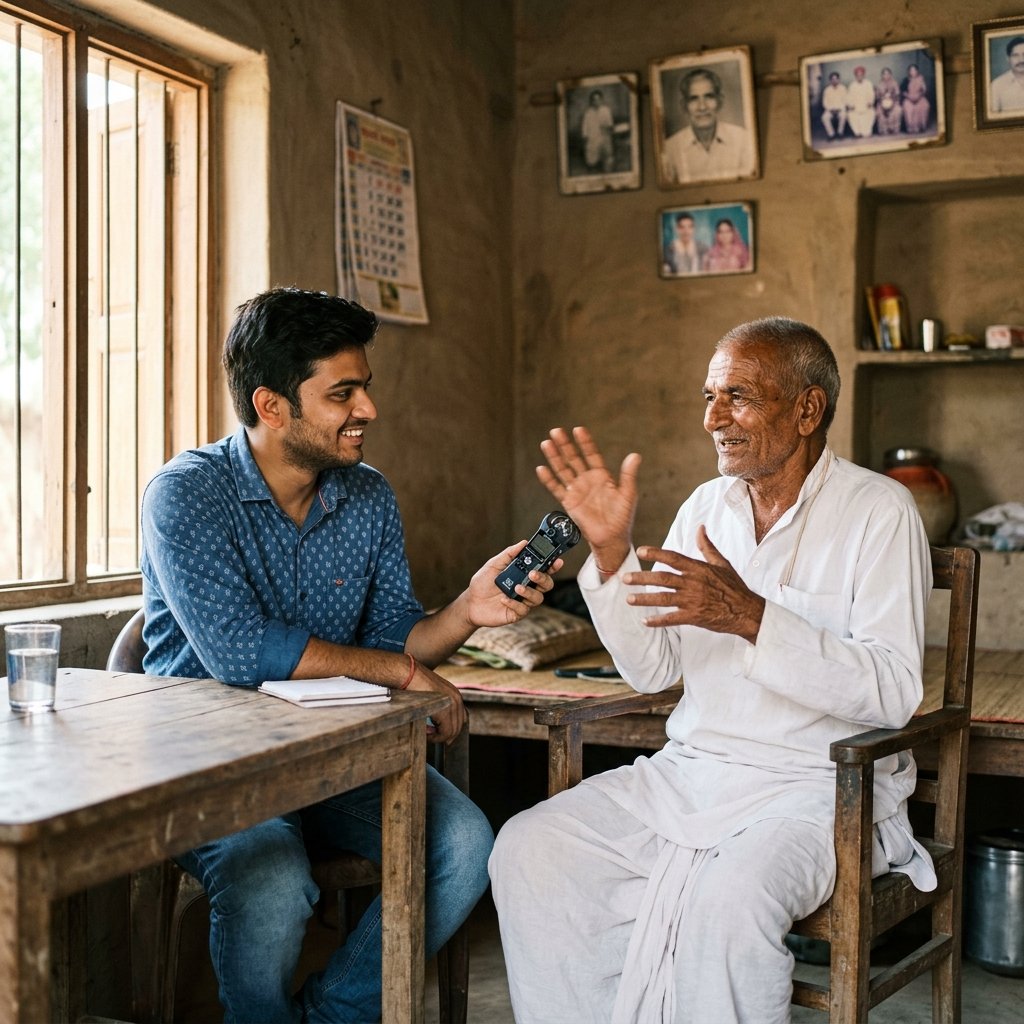
Oral histories are spoken memories and stories collected from family members — particularly elders — through recorded conversation and interview. They capture not just facts but feeling: the texture of a voice, the hesitation before a difficult memory, the laughter at something long past. Audio and video recordings preserve what written documents cannot.
Why It Matters
India's oral tradition is one of the most ancient and sophisticated in the world. Families across every community have transmitted knowledge, values, and identity through speaking and listening for millennia. Recording these oral accounts before elders pass is a matter of profound cultural urgency — each recording is a priceless human artefact.
Example of What Can Be PreservedA series of eight audio-recorded conversations with a ninety-year-old grandmother in Lucknow, conducted by her grandchildren, covering her memories of life before partition, the sound of the city she grew up in, her wedding customs, and her recipes for dishes no one else in the family knows how to make.
Senior Citizen Knowledge
What It Means
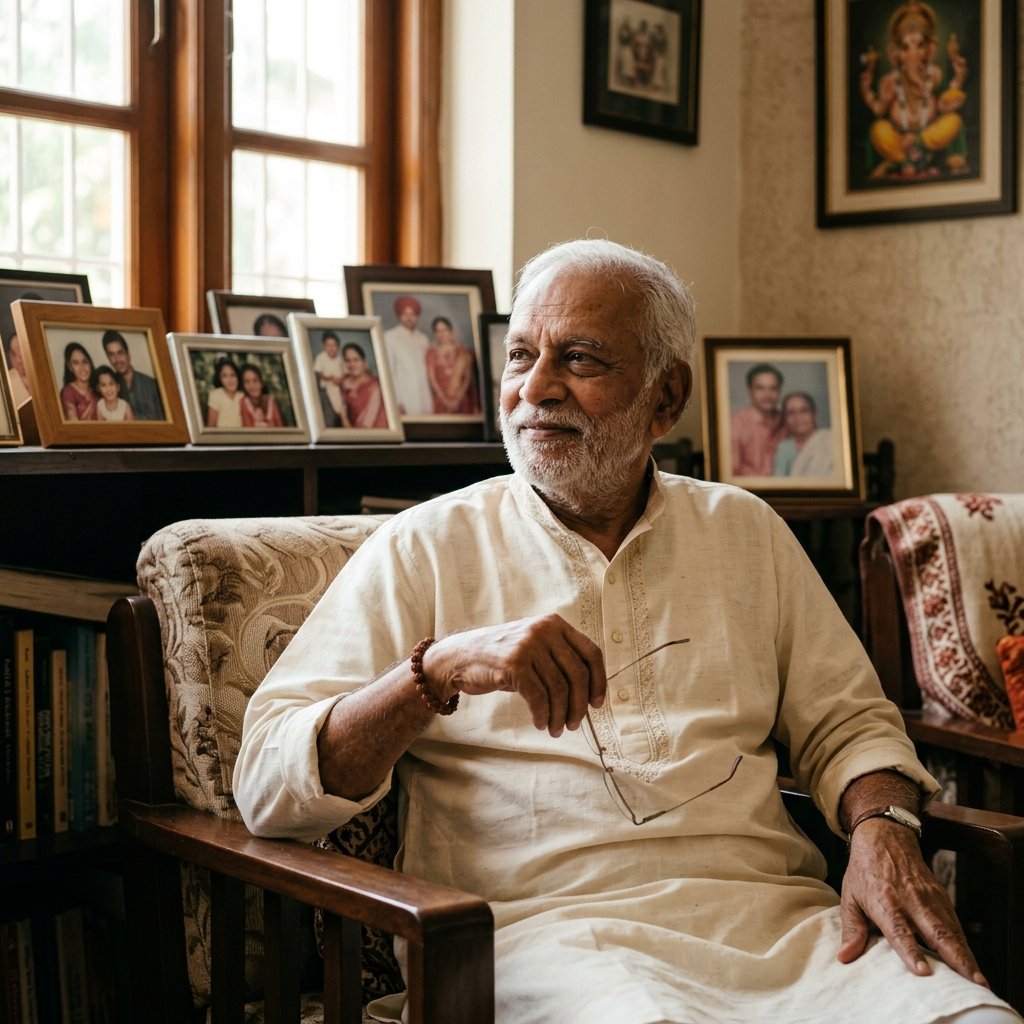
Senior citizen knowledge refers to the accumulated practical wisdom, professional expertise, craft skills, agricultural knowledge, herbal remedies, trade secrets, and life experience held by elderly family members. This is knowledge developed over decades of direct experience — knowledge that cannot be found in any textbook and that disappears entirely when the elder passes.
Why It Matters
India's senior generation lived through events and conditions that will never recur. They possess knowledge of traditional medicine, traditional agriculture, lost trades, and cultural practices that modern generations cannot replicate without their guidance. Capturing this knowledge is not nostalgia — it is the preservation of a living intellectual heritage of immense value.
Example of What Can Be PreservedA documented knowledge archive from a seventy-eight-year-old retired Ayurvedic practitioner in Kerala — comprising his formulations, plant identification knowledge, treatment philosophies, and reflections on the differences between traditional and modern medical practice, recorded in Malayalam with transcription.
Family Photographs
What It Means
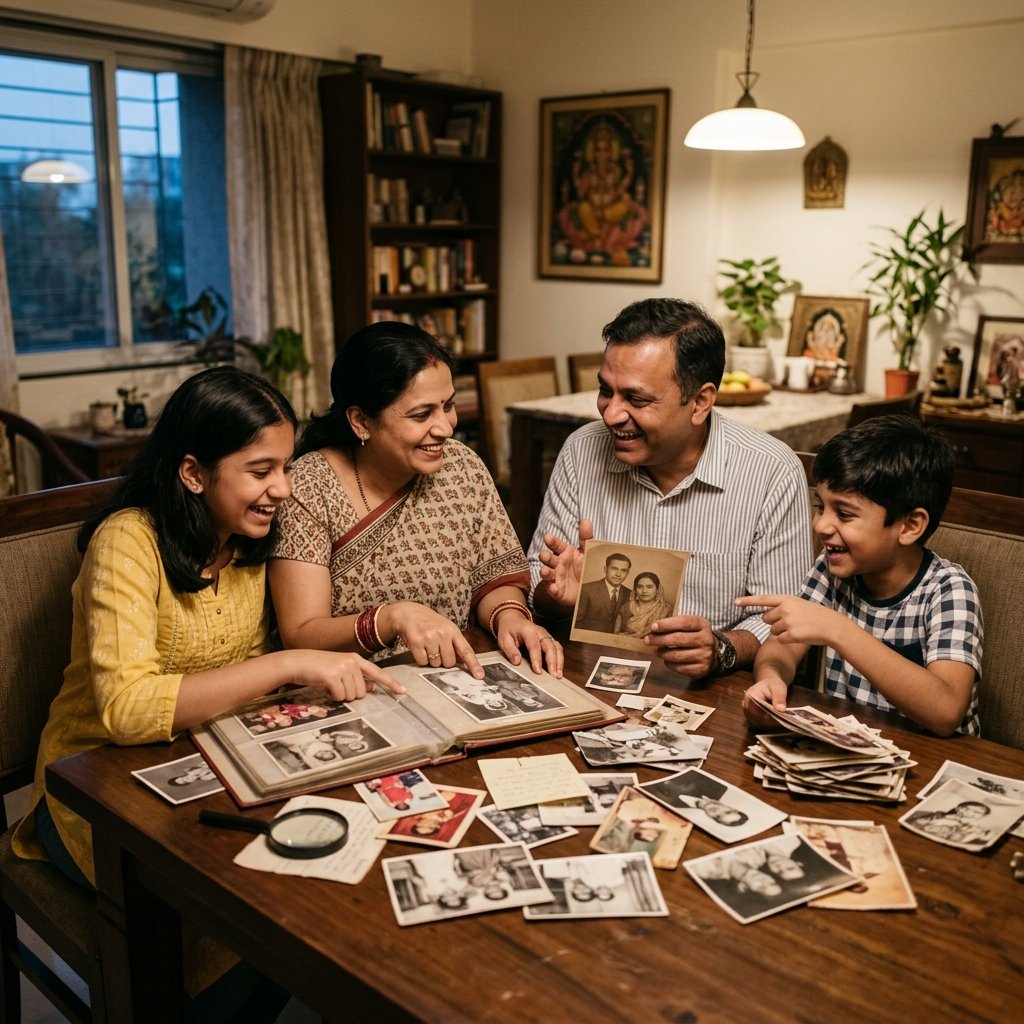
Family photographs — from faded black-and-white prints to contemporary digital images — are among the most powerful repositories of family memory. They show faces, places, occasions, and everyday moments that words alone cannot convey. They are also among the most vulnerable of all family records, easily destroyed by moisture, fire, or digital obsolescence.
Why It Matters
A photograph of a great-grandmother as a young woman, a wedding celebration from decades past, a house that no longer exists — these images connect generations in ways that transcend language. Properly preserved, annotated, and archived photographs become priceless family documents that strengthen identity and belonging across time.
Example of What Can Be PreservedA digitised, annotated collection of two hundred and forty family photographs spanning eighty years for a Bengali family in Kolkata — each image catalogued with names, dates, locations, and contextual notes gathered from elder family members, and archived in a searchable digital format.
Letters & Documents
What It Means
Letters and documents encompass the handwritten correspondence, certificates, legal records, property papers, official letters, ration cards, medical records, and personal papers that accumulate across a family's life. These physical artefacts carry history in their paper, ink, and handwriting — they are primary sources of irreplaceable historical evidence.
Why It Matters
A letter written by a great-great-grandfather is a direct connection across time. Official documents record a family's relationship with the state, with property, and with institutions across decades. These papers, once lost, can never be recovered. Digitisation, archiving, and preservation ensure their survival for generations who have not yet been born.
Example of What Can Be PreservedA preserved collection of forty-three handwritten letters exchanged between a husband and wife separated during the 1947 partition — digitised, transcribed from Urdu script, translated, and archived with historical contextual notes — now forming the centrepiece of that family's heritage archive.
Migration Histories
What It Means
Migration histories document the journeys of families who moved — for work, for education, for safety, for opportunity, or due to partition, famine, or conflict. They record where a family came from, why they left, how they travelled, what they found, and how they made a new home. Migration is one of the defining experiences of Indian family life across generations.
Why It Matters
India's demographic and social landscape is the cumulative result of countless family migrations over centuries. From partition refugees to economic migrants, from urban settlers to diaspora communities across the world — every migration story is a story of courage, adaptation, and resilience. Without documentation, these stories vanish within a single generation.
Example of What Can Be PreservedA documented migration history of a Sindhi family that fled Karachi in 1947, lived in a refugee camp in Rajasthan, rebuilt in Ulhasnagar, and gradually established a successful business in Mumbai — traced through interviews with three generations, old photographs, and the few documents that survived the flight.
Family Achievements
What It Means
Family achievements encompass the professional, academic, creative, athletic, social, and community accomplishments of family members across generations. These include formal recognition such as degrees and awards, but also less visible contributions — the farmer who revived a dying crop variety, the mother who taught an entire village to read, the craftsman who won national recognition for his weaving.
Why It Matters
Achievement is often experienced and then forgotten. Within a generation, the significance of what family members accomplished can fade from memory — especially the achievements of women, of those in traditional occupations, and of those who served their communities without formal recognition. Documentation restores dignity and inspires future generations.
Example of What Can Be PreservedA curated family achievement archive for a Telugu family spanning sixty years — including a grandfather's Padma Shri in literature, a daughter's international chess championship, a son's environmental conservation work, and the grandmother's sixty years of social work in village education, all documented with photographs and citations.
Family Values
What It Means
Family values are the principles, beliefs, ethical standards, and moral guidance that a family has consciously or unconsciously transmitted across generations. These may be articulated as explicit mottos or proverbs, or they may be embedded in the patterns of how the family makes decisions, resolves conflict, treats others, and understands its place in the world.
Why It Matters
Values are the most intangible and most powerful component of family heritage. They shape behaviour, identity, and character across generations — often without anyone articulating them explicitly. Documenting and reflecting on family values allows each generation to consciously inherit, question, and build upon the moral legacy of those who came before them.
Example of What Can Be PreservedA written document capturing the core values of a Marwari business family across five generations — including their founding principle of doing business with integrity even when it means taking a loss, their tradition of setting aside one-tenth of earnings for community welfare, and their philosophy of education as non-negotiable for all children, daughters and sons alike.
Cultural Practices
What It Means
Cultural practices encompass the rituals, ceremonies, festivals, everyday customs, and observances that are unique to a family, community, or region. These include the particular way a family celebrates a festival, the rituals surrounding birth and death, the prayers offered at specific times, and the small daily practices that give life structure and meaning.
Why It Matters
India's cultural diversity exists not at the national level but at the family and village level — in the specific way one family performs a puja that differs from their neighbours, in the wedding custom that belongs only to their community. This granular cultural knowledge is disappearing rapidly as urbanisation and modernisation standardise practice. Every preserved ritual is a contribution to India's living cultural archive.
Example of What Can Be PreservedA documented record of the unique Ganesh Chaturthi traditions of a Konkani family — including the specific form of the idol they commission, the songs sung at particular moments, the foods prepared on each of the ten days, and the family stories attached to why each custom began, gathered across three generations of participants.
Regional Languages
What It Means
Regional languages include not just the major scheduled languages of India but the dialects, sub-dialects, regional vocabularies, folk expressions, and minority languages spoken within families and communities. Many Indian families speak a home language that differs from the official language of their state — a dialect or regional tongue often unknown to the generation born in cities.
Why It Matters
UNESCO estimates that hundreds of Indian languages and dialects face endangerment. When the last speaker of a language dies, a unique way of perceiving and describing the world disappears with them. Families are the last repository of many regional dialects — recording elders speaking in their native tongue, capturing vocabulary, proverbs, and expressions, is an act of profound cultural and linguistic preservation.
Example of What Can Be PreservedAn audio archive of a ninety-three-year-old elder speaking in Gondi — a tribal language of Central India — sharing traditional stories, proverbs, and farming knowledge in her native dialect, recorded and transcribed by her grandchildren with academic support, preserving vocabulary that exists in no dictionary.
Folk Stories & Traditions
What It Means
Folk stories and traditions include the stories, proverbs, riddles, folk songs, lullabies, cautionary tales, and oral narratives that have been passed within a family or community across generations. These are often told at specific times — at bedtime, during festivals, during agricultural seasons — and they encode cultural wisdom, moral values, and historical memory in narrative form.
Why It Matters
Folk stories and oral traditions are among the oldest forms of human knowledge transmission. They carry cultural memory that formal history does not record — the knowledge of a river's moods, the wisdom of a particular season, the dangers of a historical enemy. As urbanisation breaks the cycle of storytelling between generations, this knowledge faces extinction. Recording it is a matter of cultural emergency.
Example of What Can Be PreservedA collected archive of thirty-two folk stories from a Rajasthani family — told in Marwari by two generations of elders — including tales of historical heroes, cautionary stories about greed and pride, stories explaining the origin of local place names, and lullabies sung across five generations of children in the family.
Recipes & Food Heritage
What It Means
Family recipes and food heritage encompass the traditional dishes, cooking techniques, seasonal preparations, festival foods, medicinal food practices, and culinary knowledge held within a family. This includes not just ingredient lists but the embodied knowledge of proportion, texture, sequence, and technique — knowledge that lives in the hands and memory of those who cook.
Why It Matters
Food is one of the most emotionally powerful carriers of cultural memory. The smell of a grandmother's particular curry, the texture of a festival sweet made only once a year — these are irreplaceable sensory connections to heritage. When the cook who knows the recipe passes away, the dish often disappears permanently. Family recipe archives preserve not just food but culture, memory, and identity.
Example of What Can Be PreservedA documented culinary archive from a Parsi family in Mumbai — comprising forty-two traditional recipes never written down before, including seasonal preparations tied to the Zoroastrian calendar, the precise technique for their signature dhansak, the family's medicinal food traditions, and photographs of the dishes prepared by the grandmother who holds the knowledge.
Traditional Occupations
What It Means
Traditional occupations encompass the agricultural, craft, artisan, trade, and service knowledge that has been passed within families across generations. This includes farming knowledge specific to a local ecology, craft skills such as weaving, pottery, metalwork, or woodcarving, and the trade expertise of merchant families who understood specific markets and goods across centuries.
Why It Matters
India's extraordinarily diverse craft and agricultural heritage is encoded in the bodies and memories of its traditional practitioners. When a master weaver or potter passes without transmitting their knowledge, that tradition — sometimes thousands of years old — can be permanently lost. Documentation creates a record that allows traditions to survive even when they cannot be directly transmitted through practice.
Example of What Can Be PreservedA documented knowledge archive from a fourth-generation Kanchipuram silk weaver — capturing the specific loom techniques, dyeing processes, pattern vocabulary, thread selection knowledge, and the family's history of connections to royal patronage — recorded in Tamil with photographs and video of the weaving process before the family's workshop closes.
Community Heritage
What It Means
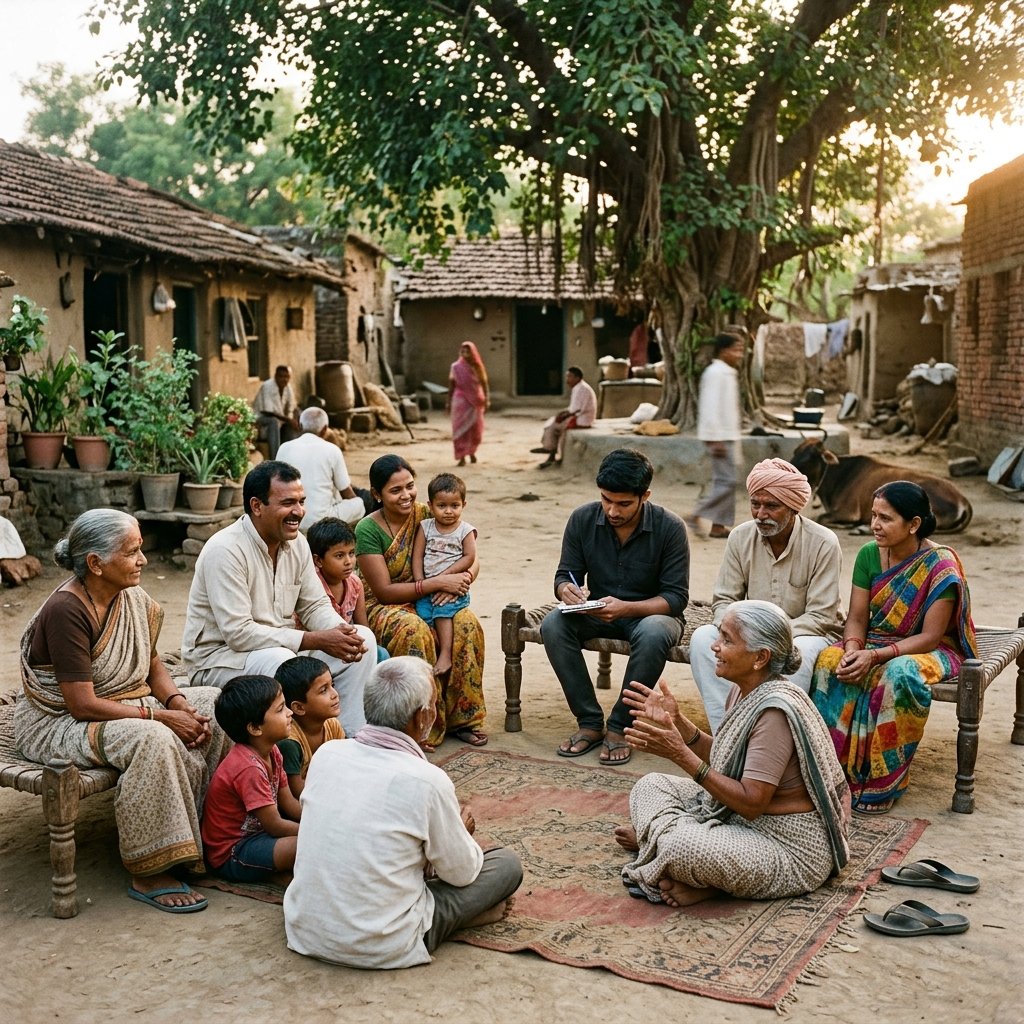
Community heritage encompasses the shared histories, cultural practices, social structures, and collective memories of communities — whether defined by caste, religion, occupation, geography, or neighbourhood. These are the stories not of one family but of the group of families whose lives have been intertwined across generations, shaping a shared identity larger than any individual lineage.
Why It Matters
India's extraordinary social fabric is woven from thousands of distinct communities, each with its own history, practices, and knowledge systems. As communities disperse, modernise, and assimilate, their distinct identities are at risk of dissolving into homogeneity. Preserving community heritage — the shared stories, institutions, practices, and places — maintains the diversity that makes India itself.
Example of What Can Be PreservedA community heritage archive compiled by ten families from a traditional fishing community in coastal Andhra Pradesh — documenting their seasonal fishing practices, boat-building knowledge, community governance structures, festivals, songs, and the history of their specific stretch of coastline — created collectively with community consent and ownership.
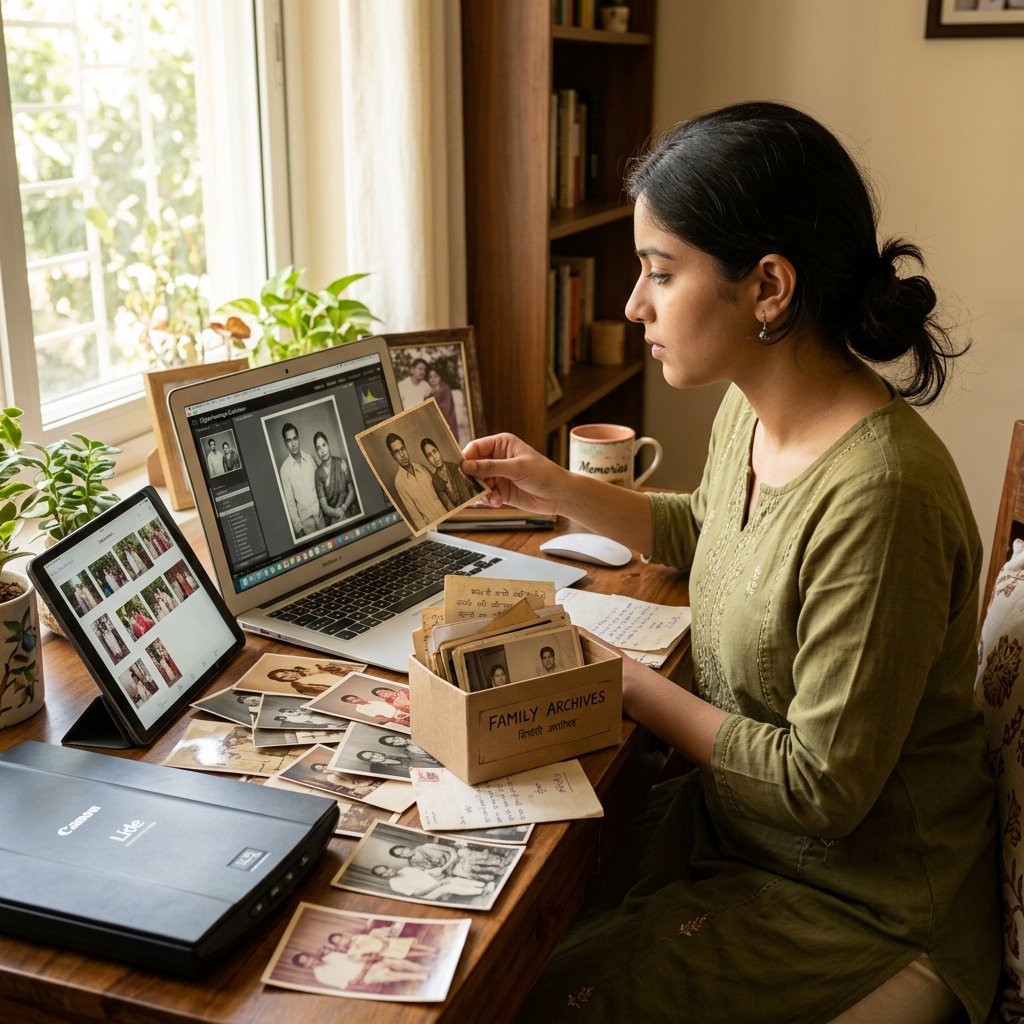
Digital Family Heritage
What It Means
Digital family heritage refers to the responsible use of digital technologies to preserve, organise, archive, and share all other forms of family heritage — combined with the preservation of digital-native family records such as social media archives, digital photographs, email correspondence, and online community histories. It is both a method and a category in its own right.
Why It Matters
Digital tools make heritage preservation more accessible than ever before. But digital records also face unique risks — format obsolescence, platform discontinuation, storage failure, and privacy breaches. Responsible digital preservation requires not just digitisation but ongoing stewardship: proper formats, redundant storage, clear consent frameworks, and thoughtful governance of who accesses what.
Example of What Can Be PreservedA complete digital family archive for a Gujarati family in the diaspora — comprising scanned documents, digitised photographs with metadata, recorded oral histories, a digital family tree, and a private family website — structured according to archival standards, stored in multiple formats, and governed by a family data consent agreement.
Your Family's Privacy Is Protected
Families retain complete control over the stories and materials they choose to share. Publication or public display requires clear, explicit, informed consent from the family at every stage. The Foundation will never share family heritage without permission.
Begin Preserving Your Family’s Heritage
Every family has a story worth preserving. Start yours today with the support of the Bharat Family Legacy Preservation Foundation.